
 Honda
 Mazda
 Mitsubishi
 Toyota
 Nissan
 JDM Parts
JDM
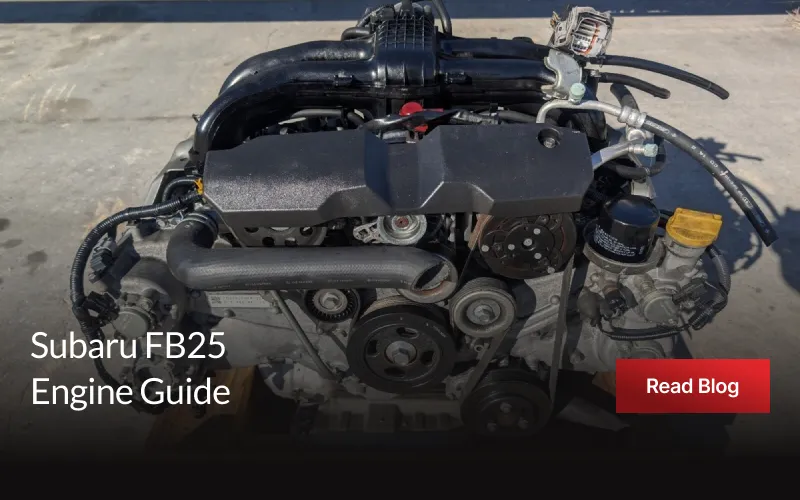
Subaru FB25 Engine Guide: Specs, Model Years and Known Problems
Nov
If you own a Subaru Forester, Legacy or Outback from the 2010s, there is a good chance you have an FB25 under the hood. This guide covers what the engine is, which cars use it, the full specs, the known problems, and what to look for when sourcing a used or JDM replacement unit.
What Is the Subaru FB25?
The FB25 is a 2.5L flat-four boxer engine that Subaru launched for the 2011 Forester. It replaced the EJ25, which had been in production since the mid-1990s. The letters FB mark a new engine family that Subaru built from scratch with modern efficiency and reliability as the main goals.
The engine sits flat in the bay with cylinders on each side. This classic Subaru boxer layout lowers the center of gravity and contributes to the all-wheel drive balance the brand is known for. It is also what gives a Subaru its distinctive sound.
Key upgrades over the EJ25:
- Timing belt replaced by a timing chain
- Single overhead cams upgraded to dual overhead cams (DOHC)
- Slightly larger displacement: 2,498 cc vs 2,457 cc on the EJ25
- Better fuel economy across all trims
Subaru FB25 Specs
| Spec | Detail |
| Displacement | 2,498 cc (2.5L) |
| Configuration | Flat-four boxer |
| Valvetrain | DOHC, 16 valves |
| Timing system | Chain (no scheduled belt replacement) |
| Horsepower | 170 hp |
| Torque | 174 lb-ft at 4,100 rpm |
| Fuel economy (2011 Forester) | 21 mpg city / 27 mpg highway |
The torque number is worth a closer look. The old EJ25 made 170 lb-ft but peaked at 4,400 rpm. The FB25 makes 174 lb-ft at 4,100 rpm. More torque at a lower rpm means stronger pull in everyday driving without pushing the engine as hard. The 2011 Forester also improved fuel economy to 21 city versus 20 on the old unit.
FB25 vs EJ25: What Changed
Power output stayed the same at 170 hp but almost everything else improved:
- Timing: Belt replaced by chain. No more belt service every 60,000 miles.
- Cam design: Single cam per head upgraded to dual cams for better airflow and combustion efficiency.
- Displacement: Slightly bigger bore and longer stroke for more low-end pull.
- Fuel economy: Up from 20/27 (manual) and 20/26 (automatic) to a cleaner 21/27 across all trims.
One more thing worth noting: the EJ25 had a well-known head gasket problem in earlier versions. The FB25 does not carry that reputation. That fact alone is a big reason many owners prefer the FB-series when searching for a replacement engine.
FB25 vs FB20: Which One Do You Need?
The FB20 is the 2.0L version of the same FB engine family. It goes into smaller Subarus like the Impreza and XV Crosstrek. The FB25 is the 2.5L and belongs in the Forester, Legacy and Outback.
These two engines are not interchangeable. The displacement, bore, stroke, and tuning are all different. If your car originally came with a 2.0L, you need an FB20. If it came with a 2.5L, you need the FB25.
JDM Of California stocks both versions. Browse the JDM FB20 engine for the Impreza and the JDM FB20 engine for the XV Crosstrek on the product pages. Check all used JDM Subaru parts if you are not sure where to start.
Which Subarus Use the FB25?
The FB25 launched in the 2011 Forester and spread to other models in the years after:
- Subaru Forester 2.5i: 2011, 2012, 2013, 2014, 2015, 2016
- Subaru Legacy 2.5: 2013 and later
- Subaru Outback 2.5: 2013 and later
Always confirm fitment for your exact year and trim before ordering. The JDM FB25 engine for the 2011 to 2016 Forester is available at JDM Of California.
Common Subaru FB25 Problems
Oil Consumption and the 2016 Settlement
The biggest known issue with early FB25 engines was excessive oil consumption. Some owners reported losing a quart of oil every 1,000 miles, which is well above the normal range for any modern engine.
Subaru settled a class action lawsuit in January 2016. The settlement covered:
- 2.5L FB engines in the 2011 to 2014 Forester, 2013 Legacy and 2013 Outback
- 2.0L FB engines in the 2012 to 2013 Impreza and 2013 XV Crosstrek
Warranty coverage was extended from 5 years or 60,000 miles to 8 years or 100,000 miles. Claims opened April 12, 2016. Those windows are now closed.
What this means today: if you are buying a used FB25 from those early model years, pull the service records and look for a history of frequent oil top-ups. Blue smoke from the exhaust is a clear warning sign.
Other Issues to Know
Outside of oil consumption on early units, the FB25 is a fairly low-drama engine. A few minor issues show up on higher-mileage examples:
- Spark plug fouling in engines with a history of oil burning
- Gradual coolant hose wear, which is normal on any older engine
- Occasional VVT noise at cold start that clears up as oil warms up
None of these are serious. The FB25 does not carry the head gasket reputation that followed the EJ25 for years.
Is the FB25 a Good Engine?
Yes. The 2015 and 2016 Forester units are generally considered the most reliable. Subaru worked through the oil consumption issue during the settlement period, and later production units hold up well with regular care.
With consistent oil changes and basic upkeep, most FB25 engines reach 150,000 to 200,000 miles. That is a solid lifespan for a naturally aspirated engine in this segment.
If you are looking at a used unit from 2011 to 2014, pay for a compression or leak-down test before buying. It is a small cost compared to a bad surprise later.
What Is the Difference Between the FB25 and FB25BA?
The FB25BA is a later variant that adds direct injection. The base FB25 uses port injection. Direct injection improves efficiency but can cause carbon buildup on intake valves over time since fuel no longer washes over them. When sourcing a replacement, match the injection type your car originally came with. They are not straight swaps for each other.
Buying a JDM FB25 or FB20: What to Check
Before you order and before anything goes in, run through this checklist:
- Match the engine code and year range to your exact car.
- Keep your own ECU and emissions equipment. A JDM engine ships without those parts.
- Have a mechanic run a compression or leak-down test on the unit before installation.
- Follow the full install checklist to keep your warranty valid.
JDM Of California’s warranty covers 90 days on head and block internals for standard engines. A certified mechanic must perform the install. Required work includes new oil and filter, timing chain components, thermostat, water pump, a full cooling system flush, and new spark plugs.
If you are in California, engine swap regulations add another layer to the process. Blog 5 in this series covers California Engine Swap Laws in detail.
FAQs
Yes. It is more modern and better sorted than the EJ25 it replaced. Oil consumption mainly affects 2011 to 2014 production. Later years are more reliable.
With regular maintenance, most reach 150,000 to 200,000 miles.
The early EJ25 from the mid-2000s has a head gasket history. The 2011 to 2014 FB25 has an oil consumption history. Both can be fine with a solid pre-purchase inspection.
The FB25BA uses direct injection. The base FB25 uses port injection. Match what your car originally came with.
Chain. This was one of the main improvements over the belt-driven EJ25.
Not as a direct swap. Mounts and dimensions differ between generations. Pre-2011 Foresters are better served with a matching EJ25 replacement.
Find a JDM FB25 in Ontario, CA
JDM Of California stocks low-mileage FB25 and FB20 engines imported directly from Japan. Units are inspected before they ship.
Address: 1590 S Milliken Ave Ste H, Ontario, CA 91761
Phone: (909) 390-9992
Local pickup is available and we ship nationwide. Browse the full used JDM Subaru parts catalog or contact us with your year and VIN and we will point you to the right engine.
